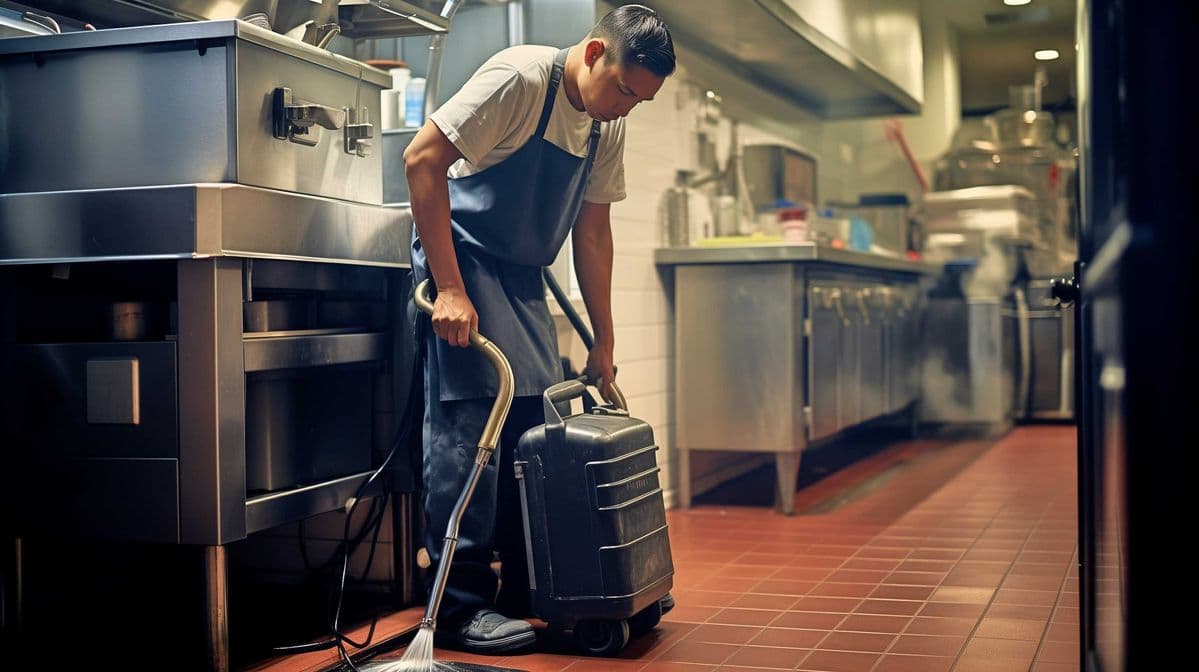
Septic Squad providing commercial grease trap cleaning at a Wimberley, Texas property
Hays County

Grease Trap Cleaningin Wimberley, Texas

Grease trap service for Wimberley's square and its cafés — where two days of visitor trade can outweigh the rest of the week entirely.

Grease Trap Cleaning in Wimberley

What to expect before you book.

County
Hays
Typical visit
30–60 min
Count in
Weekends
Protects
Your treatment unit
Call (512) 729-5861
Same-day windowsacross Hays County
Licensed & insuredTexas OSSF compliant disposal
5.0 from 249 reviewsLocally owned, 10 years
Local knowledge

Commercial Grease Trap Cleaning in Wimberley, Texas

A Wimberley kitchen's week is not distributed the way a schedule assumes. This is a weekend destination, and the trade follows: quiet weekdays, then a Saturday and Sunday that can account for the large majority of the covers. For a grease trap that means accumulation arrives in two-day bursts rather than accruing steadily, and an interval expressed in weeks will consistently misjudge it. The useful unit here is weekends served, not days elapsed — a trap that comfortably handles six quiet weekdays may be past its threshold after three busy Saturdays, and the calendar will not tell you which situation you are in.

The second thing that shapes the work is that there is no sewer to fall back on. Premises here run on their own treatment systems, and on Wimberley's ground that means aerobic units — thin patchy soil over limestone and steep slopes leave site evaluations very little else to support. Grease that escapes a trap therefore reaches a treatment unit that depends on a living biological process, and smothers it. That is not a blocked pipe with a plumber attached; it is a treatment system to replace, on terrain where replacement options are genuinely constrained. The trap is the inexpensive component standing in front of the expensive and awkward one.

The threshold itself is ordinary. Past roughly a quarter of the unit's capacity, retention time drops far enough that separation effectively stops, well before the trap looks full. There is no overflow, no alarm and no external sign — the first feedback is a slow drain, and in a small kitchen on a busy Saturday that is the worst moment to receive it.

Access around the square is the practical wrinkle: compact premises, shared rear service areas and a pedestrian district on the days you are busiest.

Why Wimberley calls Septic Squad

We count your interval in weekends rather than weeks, and we adjust it as your season moves — this is a destination town and the difference between March and July is not marginal. Servicing happens early, late, or midweek when the square is quiet, never on the days that actually matter to you. Every visit is a full evacuation rather than a skim, with walls and baffles cleared, flow control and inlet baffle confirmed, and disposal at approved Texas facilities documented. And where a premises runs its own treatment system, we can service that too, so the trap interval is set against what is genuinely reaching it.

The essentials

Grease Trap Cleaning in Wimberley: what to know

Weekend trade

Count the Saturdays, not the days

A destination town concentrates its covers into two days, so a trap accumulates in bursts. An interval written in weeks will be too frequent through a quiet stretch and too infrequent through a busy run, and the calendar gives no signal either way. Setting the schedule against weekends served rather than time elapsed is a small change in framing that makes the number actually track the load.

No sewer

Your trap guards a treatment system

Premises here run their own on-site treatment, and on this ground that means aerobic units — thin patchy soil over limestone leaves site evaluations little alternative. Escaped grease reaches a unit that runs on a biological process it will smother, and replacing one on this terrain is constrained rather than simply expensive. The trap is the cheap part protecting the part you cannot easily buy again.

On site

Compact premises, shared service areas

Kitchens around the square tend to be small, in buildings not designed around a trap, with rear service areas shared between businesses and a pedestrian district on exactly the days you are busiest. That makes timing and truck positioning part of the job. We would rather agree both once — which entrance, which hour, where the vehicle stands — than renegotiate it every visit.

What you get

What a Wimberley visit covers

The whole unit emptied

Floating grease and the solids beneath it, since leaving the bottom layer quietly shortens the next interval.

Walls and baffles cleared

Hardened residue reduces working capacity immediately, which bites hardest on a small unit taking concentrated loads.

Flow control and inlet baffle

Confirmed sound — a damaged baffle stops separation working while the trap still looks perfectly serviceable.

An interval counted in weekends

Set against the trade you actually do rather than the time that has passed, and moved as your season moves.

Timed away from your busy days

Early, late or midweek, with truck position and access agreed in advance for shared rear service areas.

Records for every service

Work and approved disposal documented, so your file is current whenever an inspector asks to see it.

Questions

Grease Trap Cleaning in Wimberley: common questions

How often should a Wimberley restaurant clean its grease trap?

Think in weekends rather than weeks. This is a destination town and most kitchens here do the bulk of their covers across two days, so accumulation arrives in bursts and an interval measured in time will misjudge it in both directions. The trigger is still the 25% rule — service before grease and solids reach a quarter of capacity — but we will express your schedule in terms of the trade you actually do.

Why does a full trap matter more here than in town?

Because there is no sewer to absorb the mistake. Premises here run their own treatment systems, so escaped grease does not travel off-site to become a municipal problem — it reaches an aerobic unit that depends on a living biological process and smothers it. On thin soil over limestone with steep slopes, replacing a failed system is constrained as well as costly.

Our kitchen is small. Does that change the interval?

It usually shortens it. A small interior unit has less capacity to absorb a concentrated weekend, so the same trade that a larger interceptor would take in its stride can push a compact trap past its threshold quickly. Unit size and load together set the number — we will look at both rather than applying a standard figure.

Can you service us without disrupting the weekend?

Yes, and we would insist on it. Most cleanings take 30 to 60 minutes and fit early, late or midweek when the square is quiet. Given the shared rear service areas around the square, agreeing the slot and the truck position once means it stops being a conversation each time.

What are the first signs we have left it too long?

Slow drains in the kitchen, then odour reaching the front of house. Both are late signals — the trap stopped separating properly some time before, because past a quarter of capacity wastewater moves through too fast for grease to rise. There is no alarm and no overflow to warn you, which is why the schedule matters more than watching for symptoms.

Do you service the septic system at the premises too?

Yes, and here that is the sensible arrangement rather than an upsell. The trap and the treatment system form one chain: whatever gets past the trap is what the system downstream has to handle. One provider seeing both means the interval can be set on evidence of what is actually arriving rather than on an assumption.

Nearby

Other areas we serve

Communities close to Wimberley, each with its own local guide.

Call Now💬 Get an Estimate
Book Online