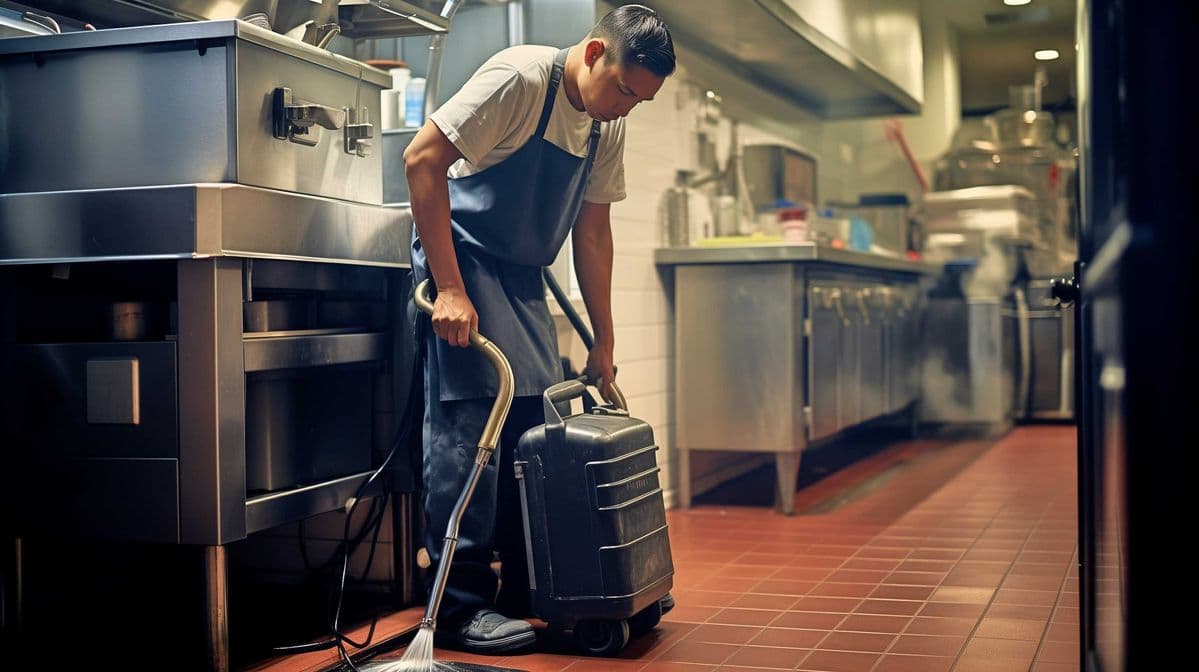
Septic Squad providing commercial grease trap cleaning at a Leander, Texas property
Williamson County

Grease Trap Cleaningin Leander, Texas

Grease trap service for Leander kitchens — the newer retail along the corridor, and the outlying premises that supply their own water and treat their own waste.

Grease Trap Cleaning in Leander

What to expect before you book.

County
Williamson
Typical visit
30–60 min
Scheduling
Off-hours
Establish first
What you're on
Call (512) 729-5861
Same-day windowsacross Williamson County
Licensed & insuredTexas OSSF compliant disposal
5.0 from 249 reviewsLocally owned, 10 years
Local knowledge

Commercial Grease Trap Cleaning in Leander, Texas

Leander's commercial food service sits at two ends of a spectrum, and which end you are at determines what a neglected grease trap actually costs you.

Most of it is newer retail along the growth corridor east of town — purpose-built units with proper installations, connected to municipal service. There the failure mode is ordinary: grease escapes the trap, hardens in the lateral, and eventually blocks something. It is expensive and disruptive and it usually arrives mid-service, but it is a plumbing problem with a plumbing solution. The more common issue in that group is simply that nobody ever set a real interval — a trap was installed as part of the fit-out, the kitchen opened, and the schedule was never established against what the business actually produces.

The other end is the outlying premises, west and northwest, where a food business may be running on its own well and its own on-site treatment system. That is a materially different situation and worth establishing rather than assuming, particularly if you took on an existing site. When a kitchen supplies its own water and treats its own waste on the same land, grease escaping a trap does not leave the property. It reaches a treatment system that depends on a living biological process, smothers it, and the dispersal field that system relies on sits on ground you also draw water from. A blocked lateral is an expense; that is a different order of problem.

The trigger is the same wherever you sit. Once accumulated grease and settled solids pass roughly a quarter of the unit's capacity, retention time drops and separation effectively stops, well before the trap looks full. What changes by premises is how fast that arrives — a function of your menu, your covers and the size of the unit you were given — and what it costs when it does.

Why Leander calls Septic Squad

For a new or newly taken-on kitchen the most useful thing we do is establish a real interval and then correct it once we have seen what actually accumulates. For outlying premises on their own system, we can service the trap and the treatment side together, which matters here because what the trap lets through is what arrives at a system you cannot cheaply replace. Every visit is a full evacuation rather than a skim, walls and baffles taken back, flow control and inlet baffle confirmed, disposal at approved Texas facilities documented. We work outside trading hours.

The essentials

Grease Trap Cleaning in Leander: what to know

First question

Municipal, or your own water and waste?

Corridor retail is generally connected to municipal service. Outlying premises west and northwest may well be running a private well and an on-site treatment system, and plenty of operators who took on an existing site have never been told which they have. The answer changes the consequence of a missed service completely, and it is the sort of thing far better established while nothing is wrong. We can usually determine it from what is on site.

On-site premises

Grease that never leaves your land

Where a kitchen treats its own waste, escaped grease reaches a system running on a biological process it will smother, and the dispersal field that system depends on sits on ground the premises may also draw water from. That is not a blocked-pipe problem with a plumber's bill — it is a treatment system to replace and, on thin western ground, restricted options for replacing it. The trap is the cheap component standing in front of all of that.

Setting it

Installed is not the same as scheduled

A trap specified during a fit-out was sized against plans rather than against the business that opened. Plenty of Leander kitchens have a perfectly adequate unit and no interval at all, because nobody handed one over. Since a trap gives no external signal until a drain slows, there is nothing to prompt a review. Setting a real interval early, and correcting it after the first service, is the cheapest maintenance decision available.

What you get

What a Leander visit covers

Full evacuation of the unit

Floating grease and the settled solids beneath it. Taking off only the top layer is what shortens every subsequent interval.

Walls and baffles taken back

Hardened build-up reduces usable capacity immediately, so a service that skips it is not really a service.

Flow control and inlet baffle

Confirmed sound. A damaged baffle stops separation working long before the unit appears anywhere near full.

An interval set, then corrected

Estimated from your unit, menu and covers, then revised once we have seen what genuinely accumulates between visits.

The treatment side too, where relevant

On premises running their own system we can service both halves, since the trap decides what the system has to cope with.

Records for every visit

Work and approved disposal documented, so the file is current whenever it is asked for.

Questions

Grease Trap Cleaning in Leander: common questions

Is my Leander premises on municipal service or its own system?

It depends where you are and it is genuinely worth establishing rather than assuming. Newer retail along the corridor is generally connected. Outlying premises west and northwest may be running a private well and an on-site treatment system. If you took on an existing fit-out and nobody told you, we can usually work it out from what is on site — and the answer changes both the stakes and what you should be keeping on file.

Why does it matter more if we are on our own system?

Because escaped grease never leaves your property. Instead of hardening in a lateral someone eventually cuts out, it reaches a treatment system that runs on a biological process grease smothers, and the dispersal field that system uses sits on the same ground your well draws from. Replacing a failed treatment system on thin western ground is expensive and your options are constrained.

We just opened. How do we set a schedule?

Start from your unit size and your real menu rather than the fit-out paperwork, then correct it after the first service. We will give you an estimated interval up front, and when we return we can see how much actually accumulated against that estimate and set a proper schedule from evidence. New kitchens almost always need that second data point, because opening projections and real trading rarely match.

How often should a Leander kitchen have its trap cleaned?

Most operations land between monthly and quarterly, set by unit size and volume rather than location. The trigger is the 25% rule — service before grease and settled solids reach a quarter of capacity, since separation effectively stops past that point while the unit still looks far from full. We will assess yours and give you a real number.

Can you service us without interrupting the kitchen?

Yes. Most cleanings run 30 to 60 minutes and fit before opening, after close, or in the afternoon lull. On outlying premises with long approaches we will agree truck positioning in advance so the visit is not being worked out while you are trying to open.

Do you cover food trucks and smaller operations?

Yes — cafés, bars, food trucks, schools, care homes and commercial kitchens of any size across Leander and Williamson County. Small units are quick jobs and we would rather build them into a route than turn them away as not worth the visit.

Nearby

Other areas we serve

Communities close to Leander, each with its own local guide.

Call Now💬 Get an Estimate
Book Online