 SEPTIC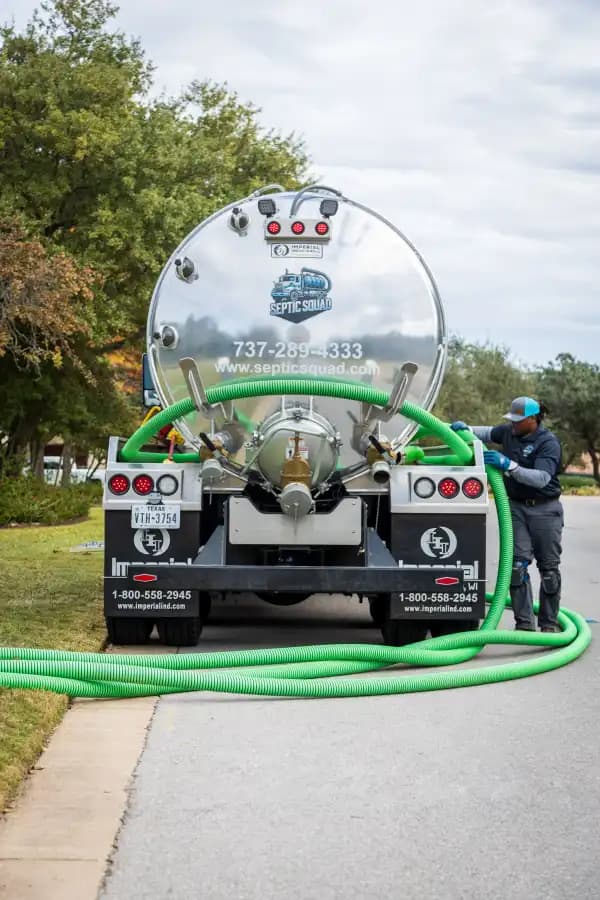
Emergency Septic Pumping in Kyle, Texas
Most Kyle emergencies are a drainfield telling you it has run out of capacity, and the trigger is usually rain. Eastern Hays soil carries enough clay to drain slowly at the best of times, and once it is saturated it accepts very little. A field that has been quietly deteriorating for years — taking on solids from a tank that went too long between pump-outs — can cope through dry weather and then stop entirely a day or two after a heavy storm. When the field stops accepting effluent the tank fills, and when the tank fills it comes back toward the house. Properties near Plum Creek and its tributaries feel this first and hardest, because that ground stays wet after the rest has drained.
That sequence is worth understanding because it changes what a call-out actually achieves. Pumping relieves the immediate situation and will usually get your household functioning again, and on a genuinely flooded-but-healthy field that is all you need — the ground drains and the system resumes. But if the field had already been clogging for years, the storm did not cause the failure so much as expose it, and pumping buys you weeks rather than fixing anything. Those two situations look identical on the night. The difference is what we find in the tank.
The other local factor is straightforward but easily overlooked: getting to you. A loaded vacuum truck across saturated pasture does more damage to your land than the wait would, and on the rural tracts where most of Kyle's remaining septic sits, that is a real consideration rather than a theoretical one. Where conditions are marginal we would rather work out an approach that keeps weight off soft ground, or in the worst cases reschedule by a day, than leave you with ruts across a field.
While you wait, stop using water entirely — no laundry, no dishwasher, minimal flushing. Keep people and animals off any surfacing wastewater.
Why Kyle calls Septic Squad
The thing we will not do is let a successful pump-out imply your problem is solved when it is not. On a Kyle system the honest answer after an emergency is often that the tank is now empty and the drainfield is still finished, and you are far better served hearing that on the night than discovering it at the next storm. We pump completely, look at sludge depth and baffle condition while the tank is open, and tell you which of the two situations you are in. We also plan the approach across your land rather than driving the shortest line to the tank.